



In 2025, more and more software solutions migrate to a microservices architecture. Partly because traditional monoliths can’t handle modern deployment speeds. Partly because cloud costs spiral when entire applications scale for single features. Partly because different teams want to use different technologies without conflicts. Partly because debugging becomes extremely complicated when millions of lines live in one codebase. But nowadays, both developers and business executives recognize that this shift isn’t just a technical trend. In many cases, shifting to microservices becomes more of a survival necessity.
There are several good reasons for this. One of them relates directly to our decade-long expertise. This reason is quite simple: microservices play perfectly into DevOps automation, meaning faster deployments, better resource optimization, cleaner monitoring, and fewer system-wide failures. With a microservices architecture, each individual service gets its own testing, deployment, and monitoring pipeline. DevOps automation services become more precise because now they target smaller, well-defined components instead of massive codebases.
So, yes, microservices and DevOps are highly compatible things. But how exactly does microservices architecture work? What makes microservices so different from the traditional approach to building applications? How do DevOps teams actually manage dozens of small services instead of one big application? What is the real role of microservices in DevOps? And most importantly, what does this mean for your project timeline and budget? So, if you still don’t know much about microservices and DevOps, join us, as today, we’ll demystify all of this using simple, clear language that cuts through the technical jargon.
What are microservices?
We covered microservices architecture extensively in our separate article about microservices in eCommerce, where we explored this approach in detail.
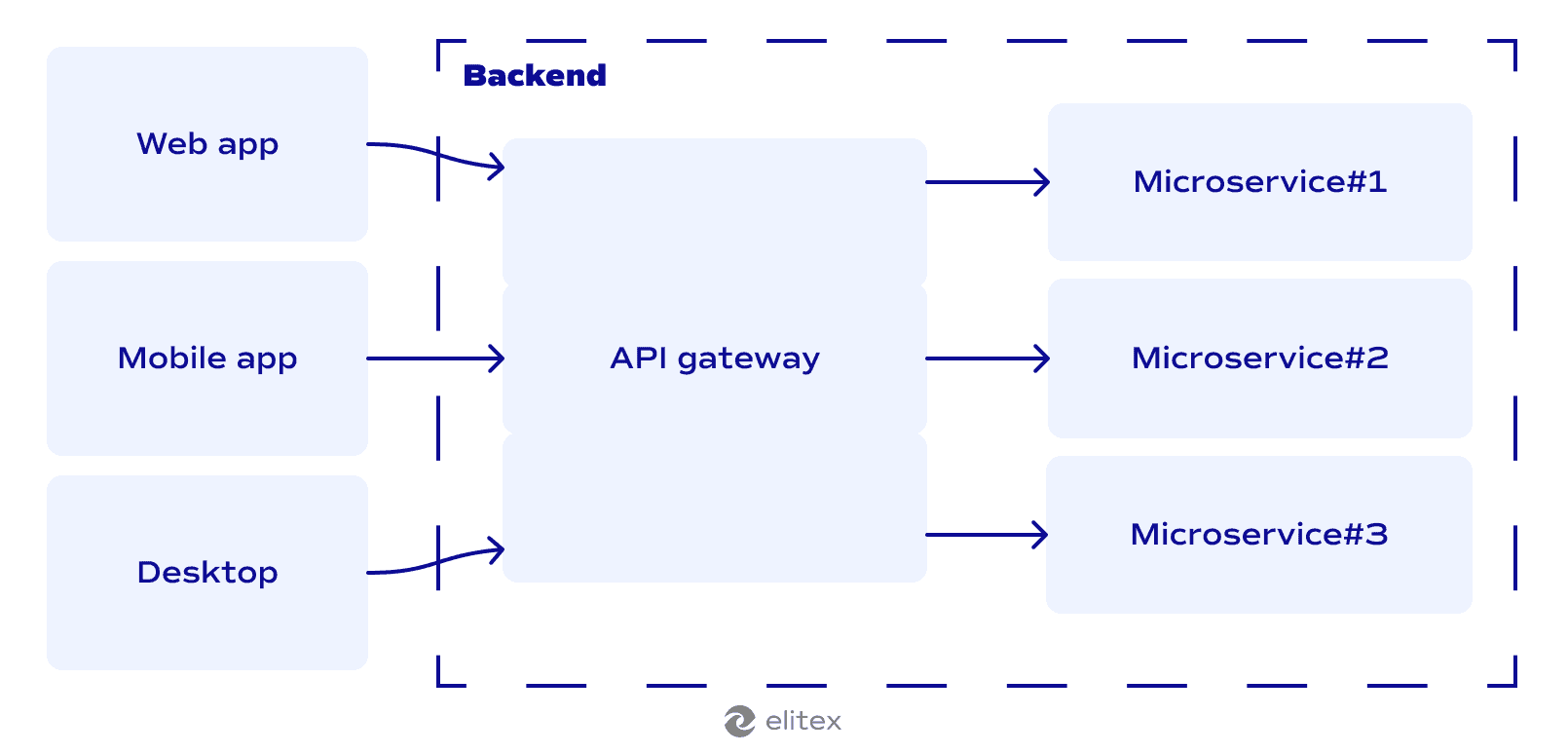
But here’s the quick summary from that article anyway: Microservice architecture is an approach that breaks large applications into small, independent services that communicate through APIs. With this approach, each service handles one specific business function and can be developed, deployed, and scaled separately. Think of it as building with LEGO blocks instead of carving from one giant stone (regarding the stone: microservices are often compared with monolithic architecture—the topic we also have a separate article for).
Here’s the simplified scheme of microservices architecture from our previous articles:
What is the specific role of microservices in DevOps?
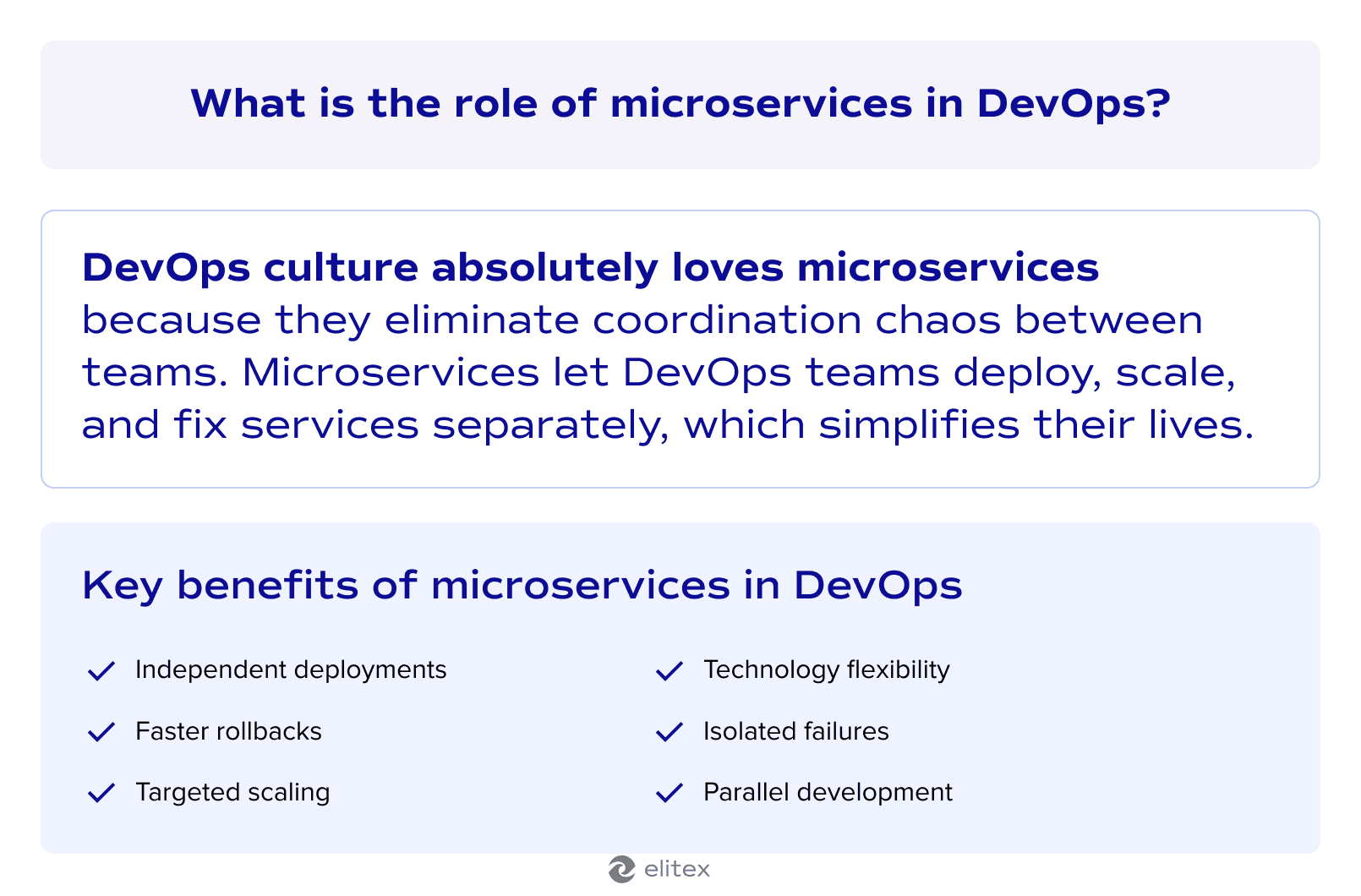
DevOps culture absolutely loves microservices because they solve the biggest pain point in software development: coordination chaos. Instead of waiting for other teams to finish their parts, DevOps teams can ship individual services whenever they’re ready. Microservices architecture fits the DevOps mindset perfectly because it enables continuous deployment, makes rollbacks less scary, and lets teams move fast without breaking literally everything. It’s like having separate kitchen stations where each chef can work independently instead of everyone crowding around one stove.
Key benefits of microservices in DevOps:
- Independent deployments: DevOps teams release services without coordinating with other departments or waiting for system-wide updates;
- Faster rollbacks: When something breaks, you revert one small service instead of the entire application;
- Targeted scaling: Scale only the services that need more resources instead of the whole system;
- Technology flexibility: Different services can use different programming languages and databases based on specific needs;
- Isolated failures: One broken service typically doesn’t crash the entire application, keeping most features running;
- Parallel development: Multiple teams work on different services simultaneously without stepping on each other’s code.
Industries that benefit from microservices architecture most
Streaming media
Video platforms serve millions of users who consume content at different intensities throughout each day. Morning commuters stream podcasts, lunch breaks bring short-form videos, and evenings deliver peak movie consumption. This creates distinct load patterns that require targeted solutions.
Content delivery networks face unique challenges compared to other platform components. These networks must cache and distribute massive video files across global servers, while user profile systems handle lightweight data queries. Video encoding services process computationally heavy tasks, yet chat features need instant response times.
The microservices approach addresses these varied demands by splitting platform functions into independent, specialized services. Each service scales according to its specific requirements rather than forcing uniform scaling across the entire system. Video encoding runs on processors optimized for parallel computing, while user authentication operates on hardware suited for rapid database queries.
This flexibility of microservices architecture proves critical during platform updates. When recommendation algorithms receive major improvements, changes affect only the recommendation service. Video streaming continues without interruption because the core delivery infrastructure operates independently. Users experience consistent performance while engineers deploy new features behind the scenes, creating a platform that adapts to real behavior patterns rather than fighting against them.
eCommerce
Online stores outgrow traditional monolithic applications quickly. Different business capabilities like payments, inventory, cards, and recommendations have varying scaling needs, and it makes microservices an ideal architectural style to implement for eCommerce platforms. Such an approach allows retailers to handle Black Friday traffic spikes in their product catalog without overprovisioning their user authentication systems. Also, it creates a situation where the shoppers still can buy products even if the recommendation system (or any other service) breaks.
Financial services
Banks face strict regulatory requirements that affect different business aspects at varying frequencies. Microservices architecture means that every single service can meet specific compliance standards without forcing the entire technology stack through lengthy approval processes. Additionally, breaking complex applications into smaller components lets developers update mobile banking UI features while keeping core transaction processing untouched, meaning less overall downtime.
Development lifecycle of microservices in DevOps
Microservices follow a structured path through the DevOps lifecycle, from initial planning to ongoing maintenance. This approach differs from traditional development primarily because each service moves through these stages independently:
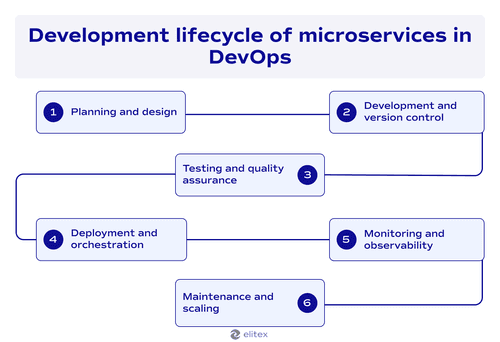
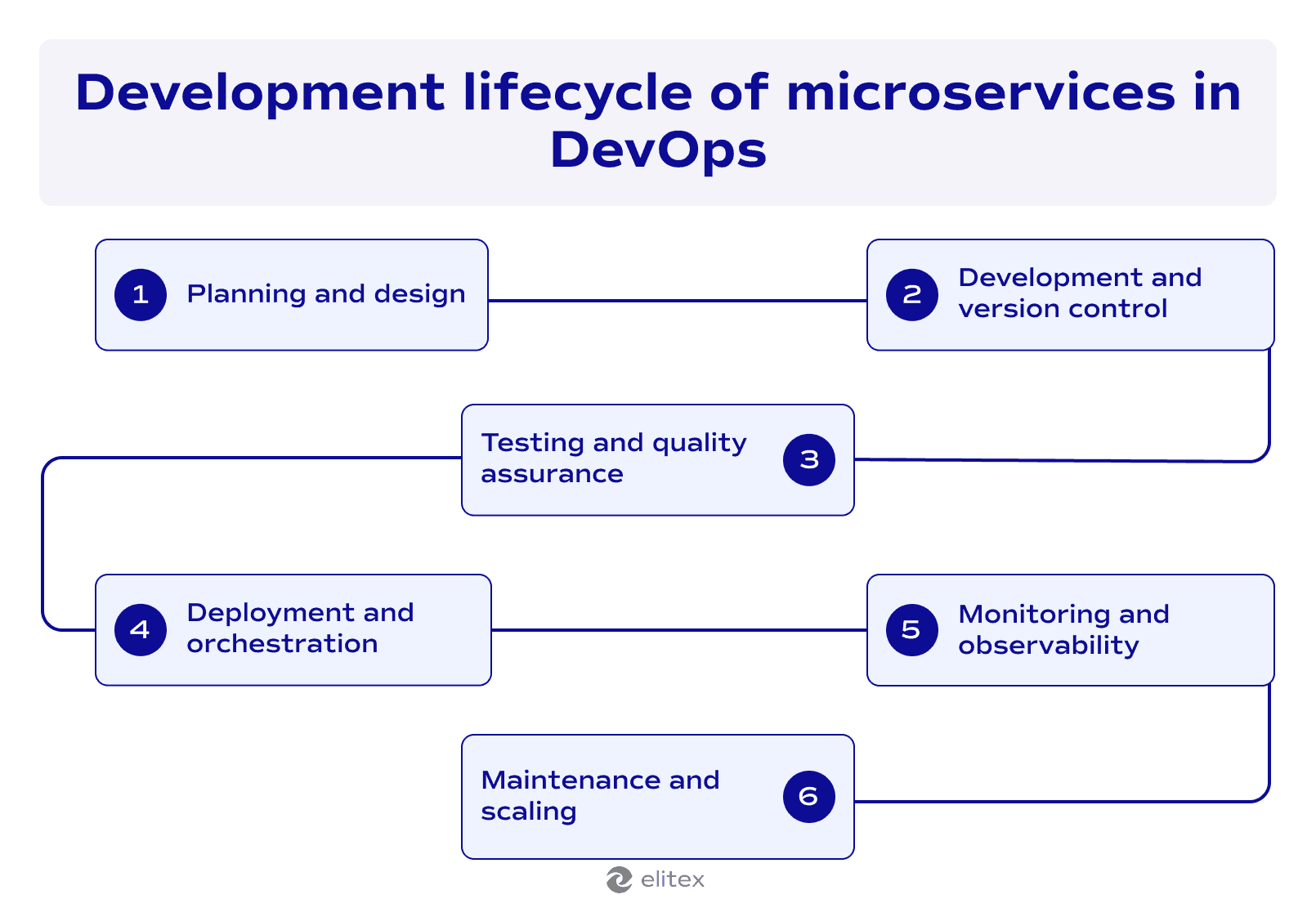
- Planning and design: DevOps teams identify boundaries for individual components based on business functions and data ownership. They create well-defined APIs for each separate service and plan deployment strategies before actual development begins.
- Development and version control: Each microservice gets its own repository with independent branching strategies within the software development lifecycle. Teams usually develop services in parallel, enabling faster development cycles through reduced coordination overhead.
- Testing and quality assurance: At this stage, DevOps specialists create automated testing that covers unit tests, integration tests, and contract testing for seamless integration of microservices. Typically, these tests run continuously and from the very early stages of the project to catch issues as early in development as possible.
- Deployment and orchestration: Continuous delivery pipelines handle the deployment of microservices independently through containers and orchestration platforms. Each service deploys on different schedules without affecting other components.
- Monitoring and observability: DevOps teams track individual service performance, logs (here we have a separate article about logging in microservices), and health metrics through centralized monitoring systems. Distributed tracing helps identify service failure patterns and isolate issues across connected services.
- Maintenance and scaling: Services scale independently based on actual usage patterns and performance needs. At this stage, teams are typically busy with updating and refactoring individual services without coordinating system-wide maintenance windows.
Tools to support microservices in DevOps
We have a comprehensive guide about DevOps automation tools, where we describe in detail which modern tools can be used across different technology stacks and deployment scenarios. Here are 6 DevOps tools specifically useful for building and maintaining applications with a microservices architecture:
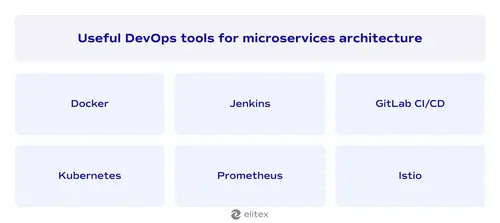
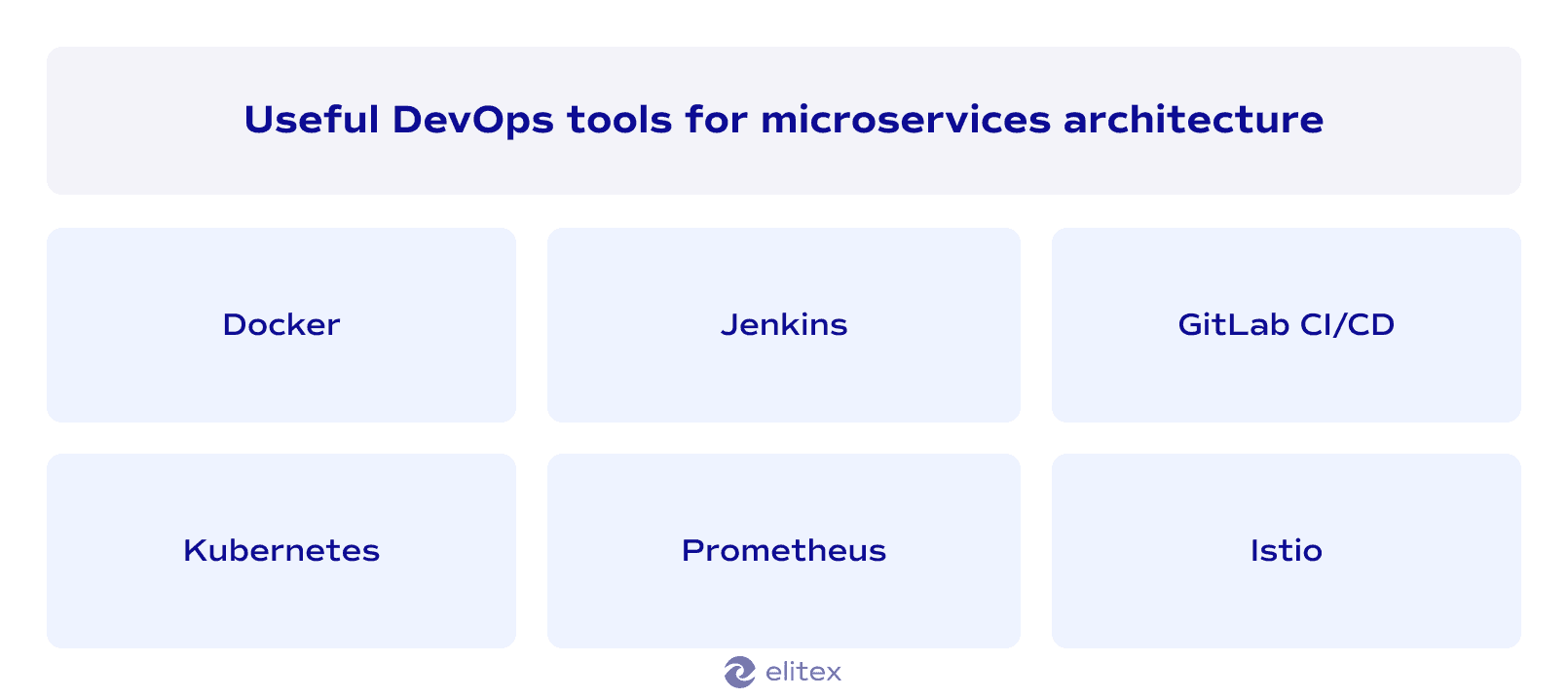
- Docker: Creates lightweight containers that package independent services with all dependencies, ensuring consistent deployment across environments.
- Kubernetes: A powerful tool that orchestrates container deployment and helps operations teams manage scaling, networking, and service discovery automatically.
- Jenkins: Automates continuous integration and deployment processes for individual microservices without affecting other components in the system.
- Prometheus: Monitoring tools that collect metrics from distributed services and provide alerting capabilities for microservices architectures.
- GitLab CI/CD: Enables development teams to build separate pipelines for each service within their technology stack.
- Istio: Service mesh that manages communication, security, and traffic routing between independent services in complex microservices deployments.
Challenges associated with microservices in DevOps and how to overcome them
But, of course, it’s not only about pros. Here are several specific challenges associated with implementing microservice architecture, and some suggestions on how to mitigate them:
- Service communication complexity: Managing communication between dozens of services creates network latency and failure points in modern applications. You need experienced DevOps specialists in order to implement service mesh tools like Istio to handle routing, load balancing, and fault tolerance automatically and avoid the situation of complex service communication.
- Distributed system monitoring: Tracking issues across multiple services becomes extremely difficult when cross-functional teams manage different parts of the source code. Using centralized logging and distributed tracing tools like Jaeger to visualize request flows and identify bottlenecks quickly may be a suitable solution for this problem.
- Data consistency: Maintaining data integrity across independent databases requires careful transaction management in modern applications. Design services with eventual consistency in mind and implement event-driven architectures with message queues for reliable data synchronization.
Real-world examples of microservices architecture implemented by our DevOps specialists
Case # 1: eCommerce solution
Our first case involves an eCommerce project where we helped Smartrr, a subscription management platform for Shopify brands. In this case, ELITEX specialists helped with the transition from a problematic monolithic application to a more efficient microservices architecture. The original monolith structure caused backend overload and performance issues, so we broke it into two separate parts that could handle requests more effectively. Our DevOps team played a crucial role by implementing centralized logging systems, monitoring dashboards, and migrating their messaging system from Amazon’s SQS to GCP pub/sub, which improved overall platform stability and prevented data loss during high-traffic periods.
Case # 2: Scientific publishing platform
Our second case demonstrates microservices implementation in academic publishing. For the STM Integrity Hub, we built AWS microservices connected by Lambda functions using an API-first approach. The platform processes manuscript submissions (its primary function) through modular screening tools while maintaining strict data privacy between publishers. In this case, our DevOps team configured deployment pipelines with API Gateway, Cognito, and DynamoDB, plus implemented DataDog monitoring that provides real-time security dashboards and catches vulnerabilities before production deployment.
Case # 3: Banking platform
Our third case involves a well-established Swiss bank (name withheld for security reasons) that needed to modernize its financial services infrastructure. The project was initially built with microservices architecture in mind, but when our DevOps specialists began to work on the project, their legacy Azure-based system had 20 interconnected microservices scattered across multiple repositories, creating high monthly costs and slow development cycles. We rebuilt all services from scratch on AWS, implemented ISTIO service mesh for better communication, and migrated to a monorepo. Our DevOps team optimized the entire technology stack, reducing infrastructure costs by 90% while significantly enhancing the platform’s security posture.
Future of microservices and DevOps
But microservices are not only about today, it’s also about tomorrow.
Just as we wrote in our article about DevOps trends, microservices architecture will likely become the default choice for enterprise applications over the next few years. Container orchestration platforms like Kubernetes will evolve to handle even more complex service meshes automatically, making microservices deployment accessible to smaller development teams. We expect to see AI-powered tools that can automatically suggest optimal service boundaries and detect performance bottlenecks across distributed systems. Most importantly, the combination of serverless computing and microservices will enable companies to build applications that scale from zero to millions of users without manual intervention.
And of course, DevOps specialists will like it:)
How can ELITEX help you with microservices and DevOps?
ELITEX bring a decade of experience in DevOps services and deep technical expertise in microservices architecture. We’ve successfully migrated monolithic applications across e-commerce, financial services, hospitality, and publishing industries. Results speak for themselves: our solutions led to up to 90% of infrastructure cost reductions and dramatically faster deployment cycles. This proven track record means we can guide your migration strategy and avoid common pitfalls that derail other projects.
Now, predicting the future is always a sort of magic, and, unfortunately, we cannot help with fortune-seeking. But we can help you build software solutions that easily adapt to whatever changes come next. Our transparent communication and zero bureaucracy approach means you work directly with our engineers, not through endless management layers. Our cross-functional teams understand both technical specificity, business timelines, and budget constraints.
Whether you’re planning your first microservices migration or optimizing existing systems, ELITEX deliver solutions beyond initial expectations!


Microservices in DevOps FAQs
What are microservices in DevOps?
It’s an architectural approach where applications are split into small, independent services that can be developed, deployed, and scaled separately using DevOps automation tools and practices.
What are the main benefits of microservices in DevOps?
Teams can deploy individual services without affecting the entire system, scale specific components based on demand, use different technologies for different services, and achieve faster recovery from failures.
Which tools work best for DevOps microservices?
Docker for containerization, Kubernetes for orchestration, Jenkins for CI/CD pipelines, Prometheus for monitoring, and service mesh tools like Istio for configuration management.
What are the biggest challenges in DevOps for microservices?
Managing communication between services, maintaining data consistency across distributed databases, monitoring complex distributed systems, and coordinating deployments across multiple teams.
How long does it take to migrate microservices in DevOps?
Here, the timeline depends on application complexity and team experience/size. Most companies start with pilot services in 2-3 months, while full migration takes 6-18 months. The process is typically done incrementally rather than all at once.
How should I start with DevOps microservices implementation?
Begin with a single, less critical service to test the approach. Set up containerization and CI/CD pipeline first. Gradually break down monolithic components while building monitoring and communication systems. Microservices in DevOps require careful planning and incremental migration.
POSTED IN: